Local History Groups :: Lead Systemic Change

A Statement from Montgomery History
June 4, 2020
Montgomery History expresses its sincere condolences to the families of George Floyd, Breonna Taylor, Ahmaud Arbery, and the countless others in our country who have lost loved ones and suffered from systemic racism. As an organization we are committed to using local history to build safer, more welcoming communities. We believe understanding and coming to terms with our history, including acknowledging past and present injustices, will help us move forward and realize the full potential of all the people who call Montgomery County, Maryland home.
Exploring our shared history, and the assumptions embedded within it, exposes a painful truth: the ideology of white supremacy did not die with the abolition of slavery. It festered and assumed new forms: Jim Crow laws, white terror lynchings, “separate but equal” practices, mass incarceration of African American men, housing discrimination, voter suppression, and violence against people of color. We must acknowledge that institutions traditionally associated with cultural memory, such as ours, have contributed to and supported white supremacist narratives in the past. So while some of the institutional structures of racism have been partially mitigated by legal rules, the root problem persists.
Montgomery History will continue to forge a new, more inclusive narrative that celebrates diversity and provides a platform for all voices to be heard. We ask that you join with us by offering your guidance and vision. Share with us your stories, your ideas, and your aspirations. We invite you to participate in telling the story of Montgomery County so that meaningful change, informed by our collective past, will emerge from our grief and disillusionment. We are optimistic that history will look back at this point in time and see a community that chose a path to the future rooted in empathy, mutual respect, and dignity.
-The Montgomery History Family
Admitting bias is first step. Thank you Montgomery History!
Will all the other U.S. cities and counties named Montgomery step up?
I was raised in Montgomery County, Maryland named for General Richard Montgomery a Major General in the Continental Army who was killed in 1775 during the Battle of Quebec during the American Revolutionary War.  There were other earlier Battles of Quebec during the French and Indian Wars.  I had to review these facts quickly.  Thank you Wikipedia !
 Could Montgomery History host a Wikipedia Edit-a-thon open to the community? During “Wiki-Thons” groups and individuals create content and upload open source photographs to Wikipedia during an intensive seminar that enhances learning resources about a particular subject.  The history, communities, demography and diversity of Montgomery County, Maryland could be just such a subject. Volunteer mentors from the community who are Wikipedians assist the content producers.
About Diversity
There are many people living in Montgomery County – perhaps all Americans, truth be told – who represent an array of all the world’s indigenous gene pool. It has long been known that proving “racial difference” is a fog of nonsense by pseudo-scientists, mostly male, to perpetuate their social and economic position. Scientific racism endures, as this 2006 research analysis states, published by the  McGill Journal of Medicine.
So, ‘fess up, admit it, everybody has many types and ties to different blood, genes and intellect.  We inherit these traits and markers individually from our ancestors, not as a group. If you missed out on learning Biology or were prohibited by a church sect or cult from learning  the Science of Evolution here is a glossary of terms related to genetic evolution.
Change Concepts :: Concept Changes
I am wondering, has Montgomery Historical Society or any historical society ever prepared an exhibition with a theme examining how we are all “colored people” ?
That was the polite term used to define and segregate citizens of all ages when I attended the Montgomery County Public School System in the 1950s. And there were other terms, bullying pejoratives that are still in trade.
Can the various community groups dedicated to supporting local history and honest, transparent education come together and consider a suggestion:  Look into the historical association’s photo archives – and those of other local organizations.  Seek out personal archives and collections dedicated to honoring historical documentation. Discover an array of materials that highlight the concept that “Blue, Black, Purple, Yellow, Red and Brown People are Normal People” are “We the People”.
The June 4, 2020 Statement at the top of this posting was sent by email; I could not find it on the Montgomery History website.  As alluded to in the Statement, over the years, it is possible that intransigent curators and managers at the Montgomery Historical Society routinely ignored or did not actively search for images, oral history transcripts, artifacts and newspaper content that depict the normal day to day interaction of all kinds of local Montgomery County residents and visitors. Oh, except during Black History Month of course.
Or, they did, but few know about it.  Admitting past bias is not enough. Though it is encouraging that the message was crafted and distributed.
Controversy and Disruptive Innovation :: If not now, when?
Has Montgomery History already mounted such an exhibition, created videos or amassed such a truthful resource as I describe?  I admit, I have visited only once, in the late 1970s and saw the entrenched, staid focus on polite and white insular society. Has Montgomery History or the Maryland Historical Society ever offered an educational product or display exposing the rancid KKK and disguised fraternal supremacist groups that continue to exist in the county and state and country?
Has Montgomery History ever offered a program exposing the history of institution-based perpetuation of supremacy, which continues in these times?
When I participated in USG cybersecurity training and disruptive innovation simulations a decade ago, I learned that walking the perceived tightrope mindfully with a willingness to accept vilification, criticism and temporary failure during the process.  Discord with positive intentions can bring a group into creative change and social advancement. History Societies could lead honest and transparent public education.
Resources:



Museum of Political Corruption

Check the transparency and  ethics of government and corporate management daily. Maybe hourly?

Teachers, create a popular lesson by displaying the reach and excesses of political corruption all the way into the classroom.

Random browsers, visit the Facebook presence of the Museum of Political Corruption

No building is big enough to hold the documented and undocumented malfeasance of politicians and their money-bag cronies.  Mr. Big, and Mrs. Big too, built their short-cut to the big-top on a pile.  They usually don’t get caught; throw their myrmidons out as distraction bait.

Mr. Big gets a suitcase

The  Museum of Political Corruption will be located in Albany, a city-state capital thought to be the bedrock of American political corruption.  Maybe the museum library will be interested in maintaining print and digital archives of reporting on political corruption. Some writers and journalists have deep troves of subject files long predating the Internet.

Fortunately, investigative reporters like Susanne Craig of The New York Times are on the case.  In May, 2017 Susanne Craig was named first winner of The Nellie Bly Award for Investigative Reporting.

Reporter Susanne Craig’s mailbox mysteriously yielded leaked pages from Donald Trump’s 1995 tax return.  A former Albany bureau chief for The Times, Susanne Craig has also led investigations into allegations of wrongdoing in state government, such as New York Gov. Andrew Cuomo’s decision to shut down a much-heralded commission investigating public corruption.

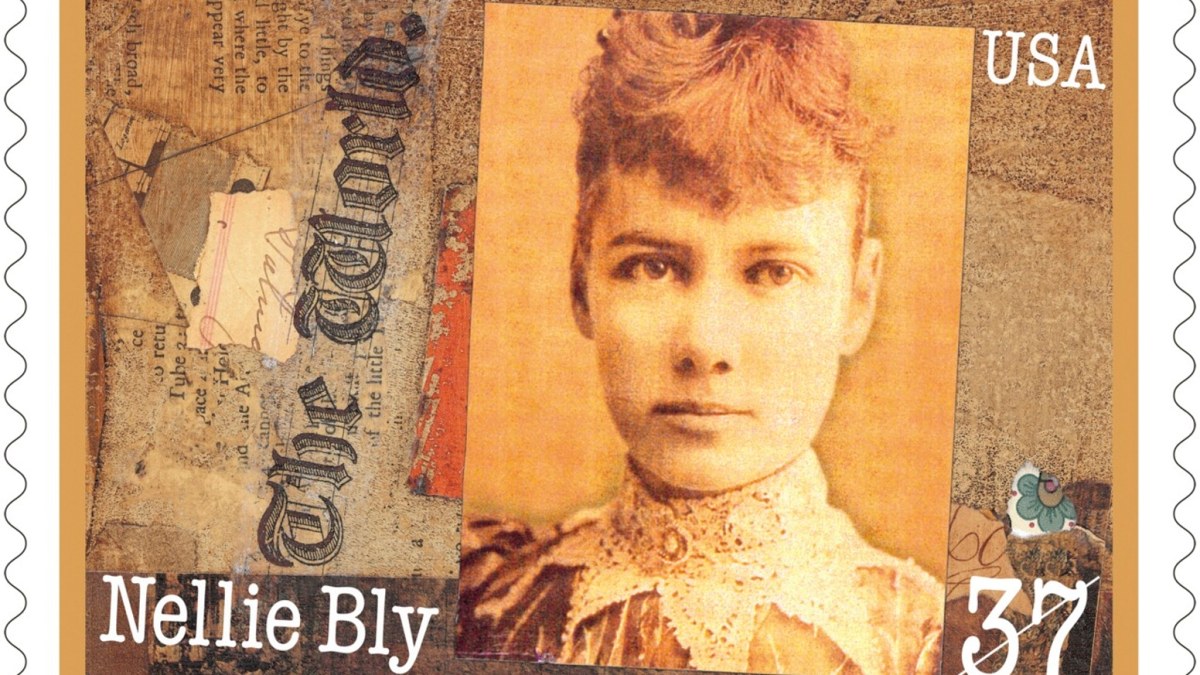
The Museum of Political Corruption established the Nellie Bly Award to recognize the vital role investigative reporting plays in government oversight and maintaining an informed electorate.  The award is named after late 1800s pioneering investigative reporter Nellie Bly.

Nellie Bly stamp

Forest Glen :: National Park Seminary

Once upon a time the land surrounding Washington, D.C. was forested. Residents escaped the summer heat of the city for the highlands of Forest Glen just over the border between Washington and Montgomery County Maryland. In 1894, a  posh boarding school for young ladies was shaped out of a rustic country inn. The private school flourished until 1942, but women’s expectation for higher education evolved from sororities and social status — the finishing school atmosphere — to professional degree programs in science, education, medicine, design and the humanities. The posh school for girls closed.

During the post Viet-Nam war era, the buildings were converted to a U.S. Army research facility and recovery home for soldiers.  The structures were neglected during the Army’s ownership.

Now the buildings at National Park Seminary are offered for sale as spiffy condominium apartments and row houses.

Photographs displayed on this blogpost by L. Peat O’Neil © 2009-2016

All photographs displayed on this blogpost © L. Peat O’Neil 2009-2016

Port Tobacco, Maryland

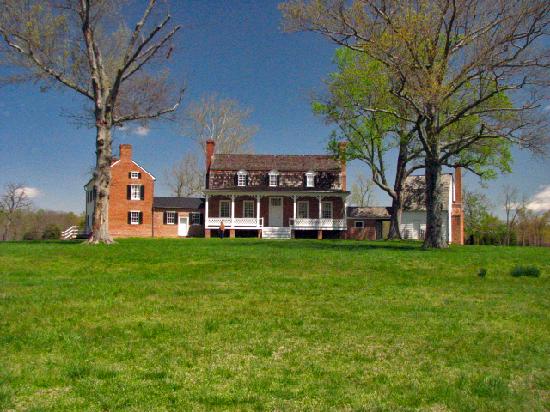
Thomas Stone National Historic Site.

Port Tobacco was not on the water when I visited.

Prior to the American Revolution, this Maryland hamlet barely an hour’s drive south-east of Washington, DC was the second largest seaport in the American colonies. Ships anchored to be loaded with barrels of tobacco bound for Europe and the rest of the world.  Port Tobacco was on the world map.

In recent decades the nearest water to Port Tobacco was a marshy stretch where archeologists are examining residue for shoe buckles, clay pipes and artifacts from the original settlers in this area, Algonquian-speaking tribal peoples.  Hardly enough water near Port Tobacco to support a kayak hull, let alone a blue water schooner.  But that’s changing, thanks to community involvement in river restoration efforts and the Port Tobacco River Conservancy

The Catholics arrived in 1658, the Episcopals next.  One hundred defined lots originally made up the town limits, but the port was growing each year.  By 1819 the community built the courthouse

Port Tobacco, Md. historic road side marker.

, now a museum.  Inside, only one original furniture piece remains, the clerk’s oak desk.   The St. Charles Hotel could seat 200 for dinner.   Sales of enslaved people for Southern Maryland plantations took place on the auction block outside the courthouse.  Sixty business and homes were listed within the incorporated area.

Tobacco was the local currency.  For the European market, the leaves were packed in kegs and shipped to England.  Most of the merchants were Scottish sea farers.  Merchants offered credit to plantation owners and it was the merchant’s responsibility to get the tobacco to Europe and England, taking their pay from the proceeds.  Surely agents, scrupulous and not, handled the sales paperwork and letters of credit.

Back in the day, there were more enslaved people of color than whites of European ancestry in the region.  After the Revolutionary War, the circuit court system was left in disarray.  The circuit court met every three or four months and the arrival of the judicial entourage signaled the opening of a fair, the market and trade season when people gathered in town to witness trials and punishments.   That was public entertainment of the era — exhibitionists in the stocks, blasphemers pilloried.  Doubtless there were worse punishments wrought.

Two newspapers operated in the town, the Port Tobacco Times and the Times Crescent.  The Maryland Independent, a relative newcomer, remains.

Warehouse Landing Road marks the location of the largest tobacco barn in the area, where they grade tobacco grown in Charles County.  During the 1920s, there were swimming camps (called  bathing camps at the time)  for children all along the river.  In 1940, the Society for the Restoration of Port Tobacco formed to preserve and protect this landmark settlement.  Catslide House was renovated. In the 1960’s, archeology dig led by the Smithsonian Institution excavated artifacts now displayed in the museum.  Elaine Racey, a Courthouse guide, dropped hints about a local ghost  while Dorothy Barbour, a docent working in the gift shop, said that more artifacts might be available for display in the museum if  a private foundation could be persuaded to sponsor a

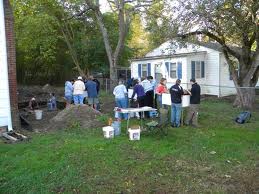
Port Tobacco Archeological Project. http://porttobaccoarcheologicalproject.blogspot.com
Port Tobacco Archeological Project. Image from http://porttobacco.blogspot.com 

fixed temperature display area.  Dr. Barbour owned Stagg Hall, one  of several historic manor houses in the area.

How did Port Tobacco lose its waterside supremacy?  Over the centuries, plantations from here to the Potomac River cleared the trees and plowed the fields for a mono-crop, poor soil management causes erosion which silted up the waterways. Even in the 21st century, storm water  runoff and erosion are primary culprits in the degradation of the Port Tobacco River Watershed and Maryland’s coastal wetland port.

Notable figures from this area include:

* Wat Bowie and Mosby’s Men

* Dr. Gustavus Brown, one of George Washington’s doctors, who hastened George Washington’s death with numerous bleedings

Olivia Floyd of Rose Hill, a spy for the Confederates during the American Civil War

John Hanson, President of the First Continental Congress

* Matthew Henson, co-discoverer of the North Pole, born near Nanjemoy, Md.

General Wm. Smallwood, a Revolutionary War leader

Thomas Stone, a signer of the Declaration of Independence

Kayaking the Chesapeake

Kayaking on the Chesapeake Bay

Kayaking will not save your soul or bring world peace, but it will move you from youth through the middling years and onward to wisdom.   We’re talking about kayak touring, not the rough and tumble white water sport that gets all the headlines and warnings.

Flat water or sea kayaks are long, stable craft, built to cut through swells and withstand wind.  There are other sports suitable for the aging weekend athlete  who wants to preserve physical dignity and prowess, but kayaking can’t be beat for visual rewards.

The views are better from a long stable kayak where  you sit on a comfortable seat, legs outstretched below deck and feet braced on pegs that connect to the kayak’s rudder.  (Not all flat water kayaks have rudders.)  During the summer,  I usually paddle without the spray skirt,  but it’s necessary when Bay chop is sweeping the boat deck or afternoon thundershowers catch you still out. No one can bail or pump accumulating water when you also clutch a double blade paddle.  A lifejacket, cockpit skirt cover, bailing pump, whistle and light are essential equipment.

Map of eastern Chesapeake Bay, Maryland.
Md DNR fishing map of Tangier Sound, Maryland

On flat water, found in the numerous inlets, rivers and tributaries of the Eastern Shore of Maryland or Southern Maryland, the land between the Potomac River and the Bay, the paddling effort is slight.  You can drift with the river current.

The Choptank and Tuckahoe Rivers water trail is particularly lovely.  When I’m out paddling the serpentine tributaries of the Chesapeake Bay watershed, I often think of the native First Peoples of the region.  The Native peoples of the Chesapeake region

“Their Manner of Fishynge in Virginia.” Theodor de Bry’s engraving of American Indians fishing, published in Thomas Hariot’s 1588 book A Briefe and True Report of the New Found Land of Virginia.

can inform modern caretakers of our waterways.

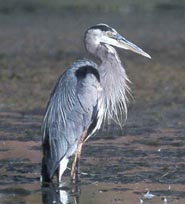
Dip, swush, dip, swush…. Paddle cadence simulates a moving meditation, a soothing zen system for approaching the universe.  Suddenly a Great Blue

Great Blue Heron bird standing near water
Great Blue Heron.

rises from a burned out tree, wing span long nearly as long as the kayak.    A turtle claps into the water, a beaver dives beneath the water.  Overhead Canada geese fly formation and there, out of the corner of my eye, a carp burns its yellow belly in the sun drenched surface of the river.  If it is evening, and a more secluded watershed, perhaps  a deer will be nibbling on tree leaves, ghosting the end of the day, marking it in my memory for all time.

Boating excursions from St. Michael’s area and beyond:

arial photo of Poplar Island in Chesapeake Bay, Md.
Poplar Island Restoration

During the 1930s, Pres. Roosevelt, (Franklin D.) visited the hunter’s clubhouse on the four-mile spit of land as  a nearby weekend retreat.   The name honors the poplar trees on the island.  The island has been undergoing restoration for years.  Dredged material has restored the island nearly to the perimeters of 1847.

South Marsh Island in Tangier Sound is under the  Maryland Department of Natural Resources Wildlife & Heritage Service.

Smith Island, Maryland is famous for its cake.  That’s right, Smith Island Cake is like none other.  The locals serve a mean crab cake too. Board the ferry at Crisfield, Md.

Tilghman  Island, Maryland offers the easy going Bay lifestyle with rental apartments for weekenders from Edge City urban areas.

Tangier Sound – If you’re out kayaking on this water, seek local information about currents and tides.  Bear in mind there are rip currents both ways and possibly, motor boats piloted by well-oiled weekend day-sailors with impaired vision for kayakers ahead.

Watts Island off Tangier Island, Virginia might be too isolated for kayaking excursions.

Watch for mid to late afternoon winds which churn up the water and make paddling a strenous activity.  Keep your eye on shoreline landmarks such as towers or buildings to measure your progress.  If you’re not moving forward, make a new heading, possibly angling to shore.  You can’t beat wind force + currents with mere muscle.

Kayak memories are soft.  The sun at day’s end, the moon on black water, reeds rustling, nutria and muskrats scurrying away. Fish slapping the water surface with a force that can only be interpreted as glee when they realize that long shark-like creature isn’t a predator.

Resources:

Maryland Online Boating Access Guide

Chesapeake Bay Foundation boating trips

Virginia Tourism on the Chesapeake Bay

Alien Weeds

Patterson Clark shared his harvesting and art making processes at the Annual Meeting of the Audubon Naturalist Society last week at Woodend Sanctuary in Chevy Chase, Maryland.

I admire his dedication and inventiveness.  Take a look at his brilliant art made of weed pulp paper and essence of weed ink, plus a ferocious amount of creative energy.

In my own quest to help native plants, I  usually pull Lonicera japonica out of the trees or bushes it is choking and weave  the vines into baskets.

Lonicera japonica aka honeysuckle.

More information:

Urban Jungle column in Washington Post

Invasive  Plant Species in the Mid-Atlantic – National Park Service

Can’t Evict an Idea

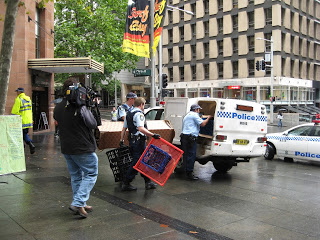
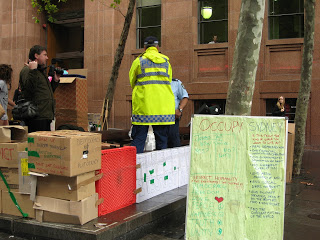
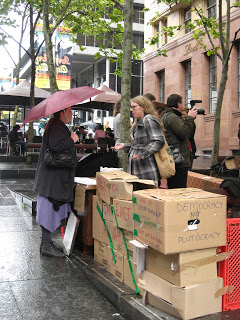
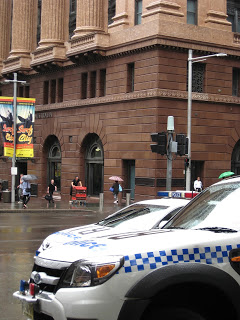
OccupySydneyBoxInstallation©LPeatO'Neil2012 Police evicting Occupy Sydney©LPeatO'Neil2012 OccupySydneyPoliceTruck©LPeatO'Neil2012 OccupySydneyPoliceCar©LPeatO'Neil2012

Occupy Sydney during 2011-12 defined their points with recycled cardboard boxes on Martin Place, a pedestrian area in downtown Sydney.


On this rainy day, I watched while police systematically dismantled the OccupySydneyPoliceRemoval©LPeatO'Neil2012cardboard box barricades and the Occupy Sydney team responded by hastily shifting position, moving their cardboard space definers to confound the police.


Occupy Sydney Installation Feb 2012


Photos of the police “evicting” Occupy Sydney protestors from a public plaza in Sydney ~

OccupySydneyPoliceStandoff©LPeatO'Neil2012 Occupy Sydney Jan2012©LPeatO'Neil2012 OccupySydneymoving©LPeatO'Neil2012 Occupy Sydney Women©LPeatO'Neil2012 OccupySydneyPolice OccupySydneyPolicevehicles©LPeatO'Neil2012


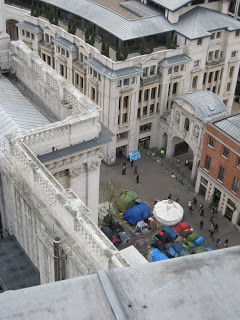
Three months earlier, in November, 2011, I’d visited the Occupy London semi-permanent base camp of tents around St. Paul’s Cathedral.

Occupy tent camp St Paul's Cathedral Nov2011©LPeatO'Neil2011

Occupy Camp London fromSt Paul's CathedralNov2011©LPeatO'Neil2011


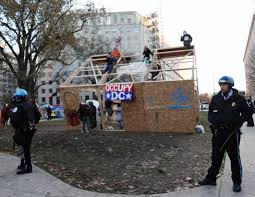
During 2011 and through the winter until June, 2012, Occupy DC protesters in Washington, DC settled in tents or tarpaulin structures in McPherson Square. By Spring, the Occupy DC movement had built wooden structures on the public park.OccupyDCprotest©LPeatO'Neiloct2011

OccupyDCmcpherson-sq©NBCnews


See: Amendment 1, The Constitution of the United States of America.  Freedom of religion, speech, and the press; rights of assembly and petition.  Congress shall make no law respecting an establishment of religion, or prohibiting the free exercise thereof; or abridging the freedom of speech, or of the press; or the right of the people peaceably to assemble, and to petition the government for a redress of grievances.

Forced removal of Occupy DC in 2012.OccupyDCend©ABCnews

Mapping Party :: Congressional Cemetery Washington DC

OpenStreetMap.org holds a mapping party at Congressional Cemetery on Sunday, July 15 10 a.m. to 3 pm.

OpenStreetMap (OSM) is a collaborative project to create a free editable map of the world. Two major driving forces behind the establishment and growth of OSM have been restrictions on use or availability of map information across much of the world and the advent of inexpensive portable satellite navigation devices.

I heard about this project at Wikimania 2012 which is going on this week at George Washington University and other venues around town including  Tech@State events.