Can’t Evict an Idea

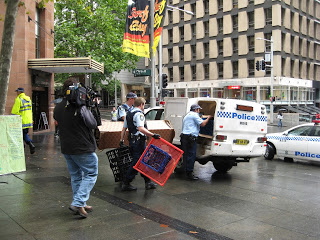
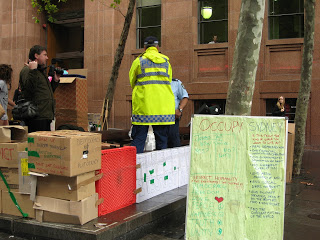
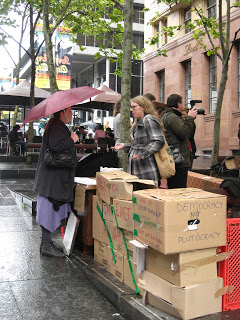
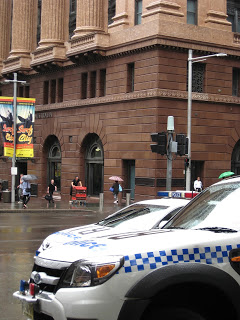
OccupySydneyBoxInstallation©LPeatO'Neil2012 Police evicting Occupy Sydney©LPeatO'Neil2012 OccupySydneyPoliceTruck©LPeatO'Neil2012 OccupySydneyPoliceCar©LPeatO'Neil2012

Occupy Sydney during 2011-12 defined their points with recycled cardboard boxes on Martin Place, a pedestrian area in downtown Sydney.


On this rainy day, I watched while police systematically dismantled the OccupySydneyPoliceRemoval©LPeatO'Neil2012cardboard box barricades and the Occupy Sydney team responded by hastily shifting position, moving their cardboard space definers to confound the police.


Occupy Sydney Installation Feb 2012


Photos of the police “evicting” Occupy Sydney protestors from a public plaza in Sydney ~

OccupySydneyPoliceStandoff©LPeatO'Neil2012 Occupy Sydney Jan2012©LPeatO'Neil2012 OccupySydneymoving©LPeatO'Neil2012 Occupy Sydney Women©LPeatO'Neil2012 OccupySydneyPolice OccupySydneyPolicevehicles©LPeatO'Neil2012


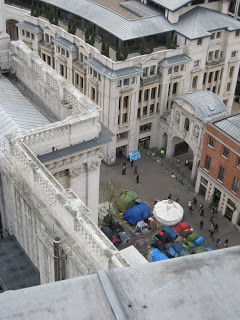
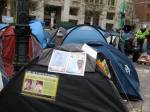
Three months earlier, in November, 2011, I’d visited the Occupy London semi-permanent base camp of tents around St. Paul’s Cathedral.

Occupy tent camp St Paul's Cathedral Nov2011©LPeatO'Neil2011

Occupy Camp London fromSt Paul's CathedralNov2011©LPeatO'Neil2011


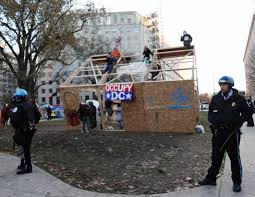
During 2011 and through the winter until June, 2012, Occupy DC protesters in Washington, DC settled in tents or tarpaulin structures in McPherson Square. By Spring, the Occupy DC movement had built wooden structures on the public park.OccupyDCprotest©LPeatO'Neiloct2011

OccupyDCmcpherson-sq©NBCnews


See: Amendment 1, The Constitution of the United States of America.  Freedom of religion, speech, and the press; rights of assembly and petition.  Congress shall make no law respecting an establishment of religion, or prohibiting the free exercise thereof; or abridging the freedom of speech, or of the press; or the right of the people peaceably to assemble, and to petition the government for a redress of grievances.

Forced removal of Occupy DC in 2012.OccupyDCend©ABCnews

Gastronomica Reader :: Wikimania 2012

The Gastronomica Reader
Univ of California Press, 2010.

What fun to find that the Gastronomica Reader , which includes my long article about Diana Kennedy and Mexican organic farming,  is on a book list run by an Estonian web-librarian!

Fun because this connects directly to last week’s Wikimania 2012 in Washington, DC where I met a wikipedian philosophy doctorate from Estonia named Raul Veede.

Synchronicity and random serendipity are the most reliable indicators I follow in order to avoid the contrived pressures of marketing, crowd control, greed and aggression.  Long live the randomness of the internet and the global volunteer efforts of wiki writers everywhere.

P.S.  If you’ve ever used Wikipedia, consider making a donation. Wikipedians are volunteers. Donations support the infrastructure and service costs.

Iatrogenic Disease :: Hello Hospitals?

[Photo too disturbing to publish goes here]

Flesh, cells and protein rot.  You’ve seen vegetables disintegrating into piles of squashed odor and off-beat color.  You’ve smelled rancid milk.  You didn’t eat that meat or the fish that seemed a little off. You know that wounds are risky sites.

Social niceness keeps us in the dark about the decadent reality of human flesh. It rots fast.  My great grand-aunt went  to gangrene (we’re so sorry, it was a hospital infection, as they used to say) while in hospital care  for a broken bone in a suburb of Washington, DC that begins with B.  I was six years old and I’ve never forgotten the odor, her pain and death.

Political and business interests avoid revealing the facts of iatrogenic disease, which is a fancy name for infection that starts in medical settings — clinics, emergency rooms, ICU, surgeries, waiting rooms, examining rooms, and all the other places where practitioners of all stripes wear latex gloves but forget to wash their hands.

Read more about staph infections and the many ways they are transmitted in medical settings.  Know the symptoms and act immediately to secure proper care.  Understand how to protect yourself from infection after or during emergency care settings, particularly in certain states, provinces, regions and countries where you’d think medical care is universally top notch, but in fact, it’s not.   Not by a long shot.  Read Ivan Illich’s book Medical Nemesis.

The key to evaluating medical care  is not counting how many successful transplants or open heart surgeries occur, nor how many elaborate imaging and analytic processes are on offer, but knowing the incidence of staph infection acquired during brief emergency room encounters or infection associated with routine procedures will help you keep your flesh, and your life.

Does the U.S. Center for Disease Control weekly Morbidity and Mortality report include iatrogenic staph infection numbers?  Australia started publishing the numbers in 2011.  Does your state or country?

Did you know common staphylococcus aureus infections are resistant to medication?

Look at this mess of medical malpractice and lack of knowledge management reported by Maureen Dowd in the New York Times.  Here’s a fast solution —  Each patient on intake receives a secure wiki page in the hospital’s online LAN on which all comment, diagnosis, data, treatment and symptoms are noted so that all practitioners, family and institutions caring for the individual can monitor progress and decline.  Maybe it will prevent decline and iatrogenic disease and death.  Wikis can be created in seconds. Any medical idiot can add content and there are certainly plenty of them to go around.

Florida  2012

http://www.cbsnews.com/8301-504763_162-57431162-10391704/aimee-copeland-24-battles-flesh-eating-necrotizing-fasciitis-following-zip-lining-accident/

“…was zip-lining last Tuesday near her home with her friends when she suffered a cut on her calf that required 22 staples to close. She came back to the emergency room at Tanner Medical Center in Carrollton, Ga. …”

Perhaps the staphylococcus aureus infection and subsequent necrotizing fascists commenced but after contact in the emergency room where her leg was stapled (!) together.  The cut wasn’t the source of infection, but the subsequent emergency room contacts infected her.

Florida 2012

http://www.firstcoastnews.com/news/article/257238/3/Starke-man-dies-after-fight-with-necrotizing-fasciitis

Florida – Tampa

http://www.dailymail.co.uk/news/article-2163297/Flesh-eating-bacteria-Lisa-Maria-Carter-sues-Tampa-hospital-losing-hands-feet.html

South Carolina 2012

http://www.wtsp.com/news/health/article/255604/12/Another-woman-victim-of-flesh-eating-bacteria

“It’s caused by two usually common bacteria, streptococcus and staphylococcus aureus …”

commonly found in hospital emergency room settings as well as on the human body.

Resources:

http://www.soilandhealth.org/03sov/0303critic/030313illich/Frame.Illich.Ch1.html

http://www.cdc.gov/mmwr/preview/mmwrhtml/mm5953a1.htm?s_cid=mm5953a1_w

http://www.fidanoski.ca/medicine/staphylococcus-streptococcus.htm

http://www.abcactionnews.com/dpp/news/state/golf-outing-palm-frond-leads-to-flesh-eating-disease-necrotizing-fasciitis-for-florida-man

http://www.amazon.com/American-Way-Death-Revisited/dp/0679771867/ref=sr_1_1?s=books&ie=UTF8&qid=1287503475&sr=1-1

http://www.ncbi.nlm.nih.gov/pubmed/18476182

Mapping Party :: Congressional Cemetery Washington DC

OpenStreetMap.org holds a mapping party at Congressional Cemetery on Sunday, July 15 10 a.m. to 3 pm.

OpenStreetMap (OSM) is a collaborative project to create a free editable map of the world. Two major driving forces behind the establishment and growth of OSM have been restrictions on use or availability of map information across much of the world and the advent of inexpensive portable satellite navigation devices.

I heard about this project at Wikimania 2012 which is going on this week at George Washington University and other venues around town including  Tech@State events.

Japanese Calligraphy :: National Geographic Society

National Geographic Society

1145 17th St. NW, Washington DC

Workshop on Calligraphy

July 8, 2012, 1 to 3 pm

The workshop opened with a discussion and projected slides that explained the differences between Western Hemisphere and Eastern Hemisphere calligraphy and writing. The way language itself is represented by these different geographic areas reflects their approaches to writing down the concepts or things expressed.

The Western Hemisphere relies on alphabets that are combined in various ways to express words that represent concepts or objects.  The Eastern Hemisphere, at least in China, Japan, Korea and other areas where Chinese culture influenced social evolution, relies on characters or symbols to represent concepts and things, often these characters are based on pictographs.  For example, the character for “mountain” looks like E turned on its spine, with the three upward spikes representing mountain peaks.

Chinese characters are called Kangi and came to Japan in the 3rd century C.E.  In Japan, these characters have been simplified visually and organized structurally to match the phonetic letters or combinations used in Japanese spoken language.  This occurred in about the 8th century C.E. and the Japanese call their characters Kana.

The function of calligraphy is also different in the two hemispheres.  In the West, the emphasis is on hand-lettering for inscriptions, decorative scrolls and ceremonial documents or occasions.  In the East the design of the word and the spirit of the word or character are considered more important when it is expressed in writing.

Training differs too:  In the West, penmanship is on the decline.  In the East, school children practice writing characters all through their primary education and scholars practice calligraphy as a zen mental relaxation exercise.

The principal styles of calligraphy in the East are: tensho, the seal script used for official purposes; the reisho script for clerical work; the kaisho for regular use; the gyosho which is semi-cursive; and the sosho which is cursive.  There is also a running style which is a very fast cursive script.  The cursive calligraphy is nearly unreadable and mostly serves as artistic decoration or design on paper.

The Tools used in Eastern calligraphy are called the “Four Treasures” and are:  natural hair brushes set in bamboo “stems”, mulberry paper, ink stick and ink stone. Mulberry paper is quite thin and until a certain level of skill is developed, students should use newsprint to practice writing ink calligraphy.  Ink sticks are made from soot remaining from burned wood or coal.  The ink stone is a shaped stone on which ink and water are mixed for the calligrapher’s use.

Our workshop assignment is to practice the characters that express the Seven Virtues of the Samuri:  Loyalty, Honor, Honesty, Respect, Benevolence, Courage, and Rectitude.  We will also practice the character for Forever which includes all the various brush directions and line weights that a calligrapher needs to learn.  The workshop leader explains the development and brush strokes for each of these characters.

While Eastern Hemisphere calligraphy is usually written from top to bottom, right to left, accommodations have been made for novice calligraphers from the Western tradition and we may write our characters left to right.

Seated at long tables covered with plastic, we each receive a little ink in a plastic dish, a natural hair brush in a bamboo “stick” and several sheets of newsprint paper and a mulberry paper with grid markings to help us properly align the character brush strokes.  We also receive a very helpful model of the characters that represent the Seven Virtues of the Samuri with the strokes marked in numerical order for correct duplication.

We watched Ms. Lok demonstrate the proper way to hold a brush and approach the paper.  She demonstrated writing each of the eight characters we would be practicing.

Then, for the next 45 minutes, the room was silent while adults and children, parents and their kids, and several single adults practiced writing Kana and learned the character virtues of a Samuri.  The writing was achieved by paying attention to the meaning built into the brush strokes that become characters representing the virtues.

As part of my year-long Mandarin language training program in 2007-2008, I had to write Chinese characters every day, but we were using pens or pencils for this activity on gridded paper, which is very different from freehand brush calligraphy.  While I have studied Italic calligraphy and am familiar with brush work from my art training and practice, I had not approached Eastern calligraphy before.  Therefore, I was a near-novice, just like everyone else in the class.  It was gratifying to see that nearly everyone managed to approach the calligraphy and focus on the spirit of the characters while also following the guidelines shown for the order of the brush strokes.

The workshop leader Ms. Lok, and her assistant (her son), walked around and helped anyone who needed specific guidance. The workshop offered special insight into the language and visual representation of Japanese and its mother language, Chinese.   The workshop was interesting, completely engaging and an appropriate length for adults or children.  The children in the audience were attentive and well behaved. A workshop aimed just at children might have less background and more practice. Some of the adults assisted each other and Ms. Lok spent time with each participant demonstrating the finer points of brush control. An excellent experience by all parameters.

Hitchhiker’s Guide to Earth

I recently learned about a project initiated by Everett Pompeii — a college student currently in Japan.

Hitchhiker’s Guide to Earth
Here are his words:
 “The more people you inspire to get out there, the better off the world is (in my view, anyway). Before we get too far, a bit about me. I’m a college student from the US, but I’m studying abroad in Japan.
On the way here, I backpacked and hitchhiked through most of Australia, New Zealand, and the East Coast of the US. I’m currently working on a how-to manual specifically for travelers like me; it’s called The Hitchhiker’s Guide to Earth.  The project is on a crowd-sourcing website called Kickstarter, and it runs until June 29, 2012
7:00 PM EST.”
Everett asked me for advice and a blog post might help spread word about his project.  Does he know I have about 20 different blogs? Check out his travel blog to learn more about this enterprising nomad’s paths.

Margaret Atwood at Georgetown University

In Gaston Hall, on the evening of April 2, 2012 Margaret Atwood mused on debt, payback, revenge and  Image  what might the world be like now if the events of September 11, 2001 has been forgiven (after a period of thoughtful mourning) by the affected nations and their political leaders instead of a trigger excuse to bomb a swath of the Middle East and Central Asia into smithereens, killing hundreds of thousands of ordinary people and extending the dull-minded cycle of revenge.

Never mind, it didn’t happen that way.  Forgiveness costs too much.

But what is the price of payback? Image

Does anyone know the number of multi-national soldiers who have died in the endless Middle East wars? Does anyone know the number of children, elders, women and men killed because they were in the way of military actions in Ir-Af-Pak during the decades after 2001?

My thought is that forgiveness is a magnificent gesture of leadership.  It would require a period of sorrowful reflection and consultation with the other countries whose nationals perished in the event.

*  2,176 of the people who died at the WTC were born in the USA.

*  573 were born in other countries.

*  Data in the report noted below are based on 2,746 death certificates filed with the Office of Vital Records and 3   deaths that were reported outside New York City through October 31, 2003.

* Data on total deaths related to the events of that day in New York, Pennsylvania and Virginia were not included in the WTC Disaster Death report authored by the City of New York.

Source: Departent of Mental and Mental Hygiene, Bureau of Vital Statistics, The City of New York.  Special Section: World Trade Center Disaster Deaths, December 2003.  http://www.nyc.gov/health

My Geographical Life

People often ask me about my travels and experiences in remote places.  My travels are indeed varied —  driving in an ancient Citroen across North Africa, camping out in scrubland or near the sea; climbing volcanos in Sumatra, Lombok, and the Moluccas; trekking in New Zealand; kayaking on Lake Biwa, Japan; and rafting and hiking in Kamchatka.

It all started with a passion for maps.  

Some of those adventures became travel articles or were anthologized in travel books.  One solo journey is recorded in detail in my book Pyrenees Pilgrimage, published in 2010.

I walked across France alone through the Pyrenees Mts. and foothills from the Atlantic Ocean to the Mediterranean Sea, a difficult and strengthening experience. I’ve planned other cross-country walking journeys which I plan to do in the coming years.

During the 1970s, I wandered North America extensively on multiple cross country trips by car, train, bus and occasionally, thumb. During one marathon drive, my siblings and father covered more than 9,000 miles in  less than 10 days.  We must have been driving night and day. I lived briefly in Missoula, MT, and for much longer periods in Santa Cruz, CA, San Francisco, CA and St. Petersburg, FL.  During the 1970s and 1980s, I spent time in every lower 48 U.S. state and camped in National or State Parks in many of the central, southern and western states. I also visited Mexico and travelled across Canada by land a couple of times.

It wasn’t until 1992 that I visited Hawai’i and I’ve returned several times. Moloki’i and Big Island are my favorites, and Kaua’i is perfect.  In 1993 I traveled along the southern area of Alaska, by sea on the state-run inland passage ferry on my way to Anchorage.  On that trip, I was headed for a month- long stay on Kamchatka across the Bering Sea.  That was when Alaska Airlines ran regular flights from Anchorage to the Russian Far East.

Other places I visited during the pre Reagan years include Sardinia, Sicily and Elba.  With my companion, I traveled by bus or train and camped out on beaches or occasionally stayed in pensions or with friends.  We traveled through Costa Rica for 2 months in the winter of 1982 and I visited   South West France many times.

After I  started working for the Washington Post and began writing travel articles for the paper and other periodicals (and later on, websites),  my travel ramped up because a few short trips were at the invitation of foreign governments (such as Yugoslavia before their civil wars) or occasionally, I would have an assignment that included travel expenses paid by magazines.

Though most people assume the bulk of my travel costs were paid for by the Washington Post, that was never the case. I worked for the Post Travel section in a freelance capacity.  Freelance writers know that magazines and newspapers usually don’t cover travel expenses.

I arranged my own long adventures with unpaid leaves of absence from work for long Asian trips during the 1980s and 1990s.  Just as I had saved for my first solo trip in 1966, I habitually worked at two or  three jobs  to support my thirst for travel.  I explored Kyrgyzstan and Uzbekistan in Central Asian on a trek with an outfitter in 1998, rather than going solo.

In all, I’ve spent time in more than 90 countries.  I’ve lived (had an address, cooked my own meals, my own library cards and/or driving permits) in China, France, Mexico, Canada and Italy.  During the years when I was living in Mexico and China, I was an employee of the US government.  I paid for my travel within those countries.

In sum, the travel writer’s lifestyle requires economic prudence and that usually means the writer needs a job.  Writing contracts that include travel expenses are infrequent.  When the urge to travel is strong, a resourceful individual will find a way.